29th September 2026 | By Admin
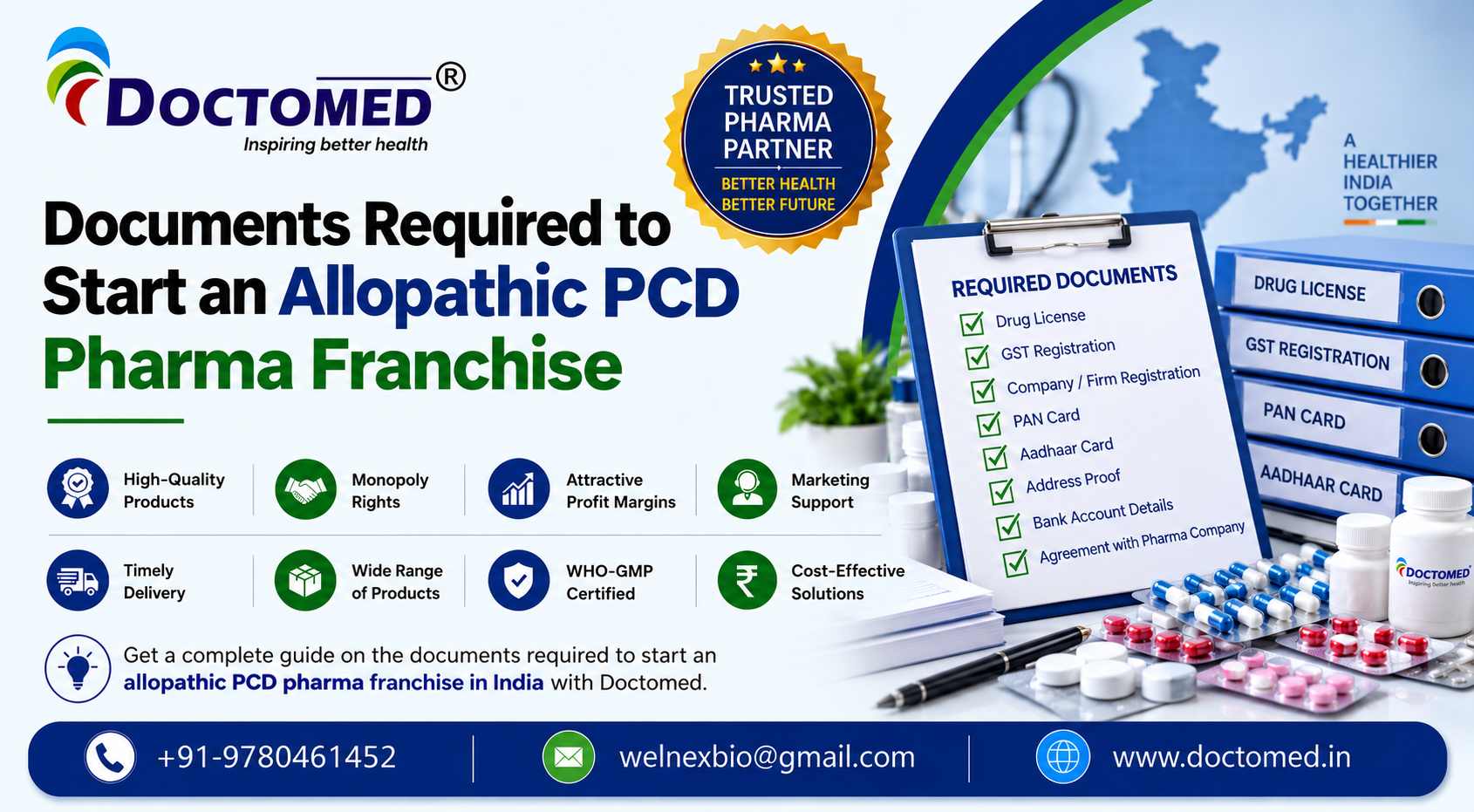
Documents required to start an Allopathic PCD Pharma Franchise generally include identity and address proof, GST registration, drug license, PAN card, business registration documents and bank details. Depending on the business structure and state requirements, additional licenses or documents may be required before starting operations.
An Allopathic PCD Pharma Franchise enables a distributor, chemist, or any other start-up entrepreneur to deal with the branded medicines produced by a company within their allocated territory. However, things will only be easy in your business if all the papers are in order. Both the company and the franchise partner need to ensure that they are legally authorized to manufacture, store, and distribute prescription as well as over-the-counter medicines. Failure to have the right licenses is the most common reason for a delay in the process or failure of the franchise due to some legal issues later. This is an explanation of the important papers that you as the franchise partner, need to have and those the reliable manufacturing company should give you. In addition, I will explain how to check both parties' licenses easily.
Allopathic PCD Pharma Franchise Explained: Why Documents Come First
Propaganda Cum Distribution is the abbreviated term used for the PCD. In this concept, the pharmaceutical company makes arrangements whereby the partner is made to enjoy the exclusive monopoly rights of promoting and selling their formulations in the specified district/state. The partner takes care of sales, field representatives and distribution in the locality, whereas the company takes responsibility for the manufacturing and supply of the products. Allopathic means conventional medicines including antibiotics, analgesics, antacids, cardiac & anti-diabetic tablets & injectables which are not included in the Ayurvedic or herbal products range.
It is always necessary to know the paperwork involved in a Pharmaceutical Franchise because the products handled here are regulated products. Your premises and qualified personnel get licensed from the drug regulators, your business gets registered with the tax authorities and an agreement will protect your territorial rights and payments. The documents can be divided into three categories: your licenses and identity proofs, the manufacturer's licenses, and the contract and other compliance papers. It will be helpful for you if you are aware of these categories before approaching any PCD Company.
In brief, you will require a legitimate drug licence with an authorized name on it, GST, PAN, proof of premises, banking information, and a signed franchise agreement. Below are the details explaining each one of these things.
Documents You Need as a Pharma PCD Franchise Partner
These may vary from state to state and company to company, but the following are mandatory for all Pharma PCD Franchise.
- Wholesale Drugs License: Given to you by your state drug control department as per the Drugs and Cosmetics Rules, 1945 in Forms 20B and 21B. If you sell drugs directly to patients, the Retail Forms 20 and 21 would be applicable. The license number gets cross-verified before sending out stock.
- Proof of Qualified Person: You need a registered pharmacist or graduate having at least one year of experience in the drug industry as the competent person for a wholesale license. Keep your registration certificate or degree, experience letter, and appointment letter handy.
- Premises Documents: Your Ownership Deed or Rent Agreement, recent electricity bill, and premises plan. Inspectors check for adequate space, racking, cleanliness and a refrigerator if you plan on storing temperature-sensitive PCD Medicine. Minimum space requirements are there, so check the existing norms with your state drug department.
- GST Registration Certificate: Every invoice you issue or receive needs a GSTIN number; no way around it.
- Documents of PAN & Aadhaar: PAN of the proprietor or company, together with Aadhaar or any other photo identity proof of the proprietor or partners.
- Documents of Constitution: Partnership deed of companies, or certificate of incorporation with MoA and AoA of the companies. Often, Shop and establishment registration/Udyam registration is also required.
- Documents of Bank Details: Cancelled cheque & sometimes the latest bank statement. These documents are used by companies for payments and credit limit assessment.
- FSSAI License: Required only if your range includes Nutraceuticals or food category products which many allopathic ranges now have.
The licenses will continue to be valid as long as you make timely payment towards the license retention fee, so you must keep those receipts with your license document.
Inconsistency is one common reason for delays in approvals. Your drug license, GST certificate and bank account details must be identical, and any inconsistency between them raises questions for both the company and the regulatory body. It’s always better to clear inconsistencies before applying because a pharmaceutical Franchise partner having inconsistencies in their records is considered as a non-compliant entity while onboarding.
Documents to Request from a PCD Company Before Joining a Branded Pharma Franchise
Verification works in both directions. A franchise is only as dependable as the manufacturer behind it, so a serious distributor should ask for proof, just as the company asks for yours.
- Manufacturing License: A valid license from the state licensing authority covering the formulations on offer. If the company outsources production, ask for the third-party manufacturer's license and the loan license details that link the marketer to that facility.
- WHO-GMP or GMP Certificate: This shows the plant follows recognised quality practices. Also ask how the facility is aligned with the revised Schedule M requirements.
- Product Permissions: A product list showing approval status for each formulation, especially fixed-dose combinations. Ensure that none of them are included in the banned combinations from the government before you decide on any Products PCD Pharma Franchise brochure.
- Proof of Trademark: Registration or application information for the trademarks, since you do not want to create demand for something that is owned by someone else.
- Quality Records: Batch-wise certificates of analysis on request, along with stability data and the company's policy on near-expiry stock.
- Commercial Papers: The company's GST certificate, a price list showing MRP, PTR, and PTS, and promotional literature such as visual aids and product monographs.
A company that hesitates to share these records is giving you useful information. Dependable PCD Pharma Products always come with transparent documentation.
Agreement, Territory and Compliance Papers for a Pharma Franchise Business
Licences prove that you can operate; the agreement defines how you will operate together. Read it line by line before signing, because it decides who carries the risk when things go wrong.
- Franchise Agreement: It must contain details regarding tenure of contract, exclusivity, territories covered, order minimums, terms of payment, promotions, and termination criteria. Find out how they handle returns of near-expiration products.
- Letter of Allocation of Territories: Document confirming the monopoly rights to a particular area, detailing the districts or territories covered, thus allowing you to solve any overlapping claims made by other distributors easily.
- Invoice along with batch number, expiry date and stock records: These are demanded anytime by the drug inspectors and will help you keep your accounts in order and make audits easy.
Do not pay any advance until you have verified certain things beforehand. Check the license number of the distributor with the licensing authority in the concerned state. Verify GSTIN on GST portal, search brand names through the trademark public search facility. Also request a plant visit or live tour via video call. This way, you will be able to differentiate the Best Pharma Franchise from a fancy brochure.
Also, maintain a well-organised online folder containing all licenses, agreements, invoices and their renewal periods. With this in mind, when you launch new PCD Pharma Franchise product ranges or get a new territory, you can send authenticated documentation within minutes, rather than going through various files. Companies appreciate this sort of preparation, and this generally leads to quick approvals and credit arrangements.
Effective PCD Franchise documentation minimizes conflicts, ensures that each batch of medicine PCD is easily traced, and creates a good impression with doctors and chemists of your territory. Whatever Pharma Franchise you opt for, paperwork should be your starting point.
FAQs on Documents for a Pharma Franchise
Q1. Is a drug license mandatory to start a PCD pharma franchise?
Yes. Distributing allopathic medicines in India requires a valid wholesale drug licence issued by the state drug control authority under the Drugs and Cosmetics Act. Without it, a manufacturer cannot legally supply you, and stock cannot be sold.
Q2. Do I need to be a pharmacist to start a Pharma Franchise Business?
Not personally, but your license needs one. A wholesale license requires a registered pharmacist, or a graduate with at least one year of drug-sales experience, as the competent person. You may employ this person.
Q3. Which documents should a PCD Company provide to franchise partners?
Make sure you get the manufacturing license, WHO and GMP certification, product certifications, GST registration, trademark information of the brand, price list and the franchise agreement in writing. Check all these against the records before giving any advance payments.
Conclusion
The procedure of initiating an Allopathic PCD Pharma Franchise takes time and is based on preparations. First of all, arrange your documents for licensing, a qualified person, GST, PAN, premises, and banking. Secondly, request documents from the company that will include the manufacturing license of the company, quality certificates, product licenses, and trademarks. It does not matter whether you opt for a branded pharma franchise or generic-based products. The rules and fees may change at any time. Therefore, consult your state drug control department and a legal expert.
Must Read: List of Top 10 Ayurvedic Companies in India – 2026-27

Doctomed is dedicated to delivering high-quality pharmaceuticals to enhance global healthcare. With a focus on innovation and excellence, we ensure safe, effective, and affordable solutions for better health.
© 2024-26 Copyright Doctomed | Designed and Developed By Rednirus Digital Media