
23rd November 2026 | By Admin
Quick Answer: The future of pharmaceutical companies in India will revolve around artificial intelligence for drug discovery, intelligent manufacturing, digital compliance, and data-driven marketing. Those companies that will use these technologies responsibly, without compromising on quality and regulatory compliance.
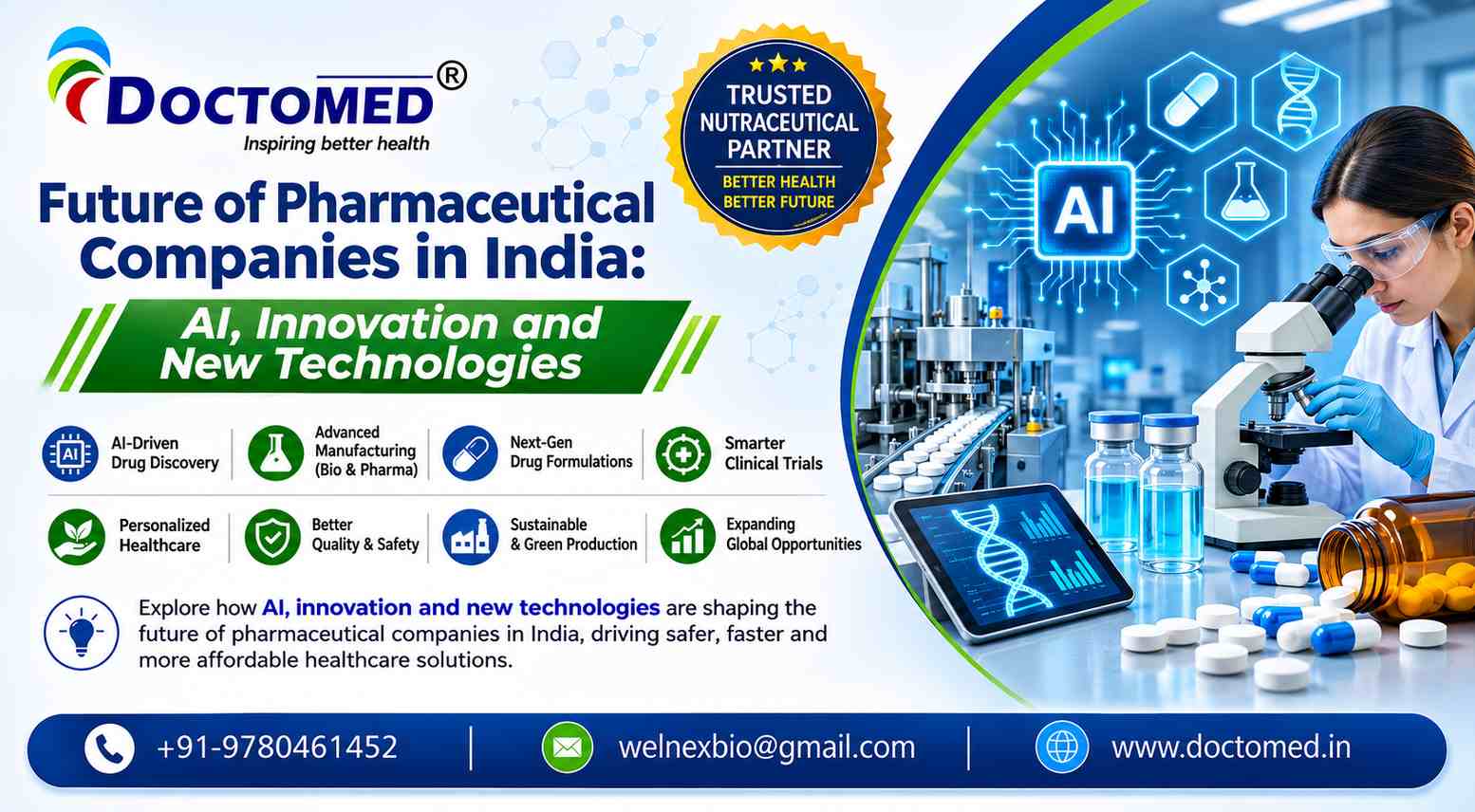
Pharmaceutical Companies in India are embarking on a journey wherein technology becomes as important as manufacturing capabilities. For many years now, this country has built a reputation based on its generics and large-scale manufacturing. Today, artificial intelligence, automation, and higher quality standards are altering the way medicines are being discovered, manufactured, and marketed. The blog is meant for pharma entrepreneurs, PCD franchise partners, distributors, and pharmaceutical marketing companies in India who are looking to learn about the future of their industry. Here you will learn how AI is being used, emerging technologies, changes in the PCD business model, and differentiating future-proof businesses from obsolete ones.
Future of Pharmaceutical Companies in India: What is Changing?
The future of the industry hinges on three transitions – more intelligent R&D, manufacturing that is connected, and business based on data. India is already providing a significant portion of the global supply of generics in terms of volume. The next step involves making a transition from volume to value.
Each Pharma Company in India today is under pressure from regulators, hospitals, and consumers. The new norms of Schedule M require companies to improve their quality systems. The Production Linked Incentive Scheme incentivizes manufacturers to invest in high-value medicines and APIs. Consumers, in turn, demand traceability rather than low prices.
All of these changes affect all sectors of the market, from research-based companies and contract manufacturers to distribution networks.
Technology is increasingly becoming the foundation for competitiveness, not the add-on layer. The business that can prove its process through documentation and traceability will gain credibility much faster than those that do not.
Export markets bring yet another layer. Regulatory agencies in the United States, Europe, and other countries scrutinize facilities closely. Any findings related to data integrity can impact approvals. Indian companies that have digitalized batch records and quality management systems are well-prepared for this kind of scrutiny.
How AI is Helping a Top Pharmaceutical Company in India Work Smarter?

There are several practical applications of artificial intelligence already in use. The benefits arise largely from increasing the speed of repetitive operations, thus allowing specialists to concentrate on decisions.
- New molecule discovery: ML models help to select molecules and predict their characteristics, thereby reducing the number of candidates prior to conducting laboratory tests.
- Clinical studies: the use of AI technologies in designing the protocol, selecting sites and selecting patients is beneficial.
- Pharmacovigilance: automation is helpful in analyzing adverse events and identifying potential signals for further examination.
- Quality control: vision technologies and predictive maintenance systems can identify defects and shifts in equipment early on.
- Supply chain: demand forecasting enables planning purchases of raw materials and minimizing shortages and expiries.
AI technologies do not replace pharmacists, scientists or regulators. All results require verification, control measures and approval. A Top Pharmaceutical Company in India will consider artificial intelligence technologies similar to any other controlled system: tested, reviewed and audited. Some teams also use AI tools to prepare and check regulatory documents.
Pharmacovigilance is a good example to discuss here. The number of cases will increase every year due to the widening portfolio of products. Automated case intake and coding systems help decrease manual processing, but the decision-making process of safety physicians who determine causality and reporting remains intact.
New Technologies Reshaping the Medicine Company in India
Outside the realm of AI, there are many other technologies that are shaping the day-to-day work of the Medicine Company in India.
- Continuous manufacturing and process analytical technology. Rather than testing at the end of the process, sensors will measure quality during manufacturing, resulting in less waste and increased consistency.
- Serialisation and traceability. Using QR codes and track-and-trace solutions will increase verification of authenticity and help fight against spurious medicines. QR codes are already required in India for selected top-selling products.
- Biosimilars and complex generics. The demand for biologicals, injections, and complex formulations is increasing and requires advanced equipment and specialist employees.
- Digital twin and IoT. It is possible to use virtual models of processes and IoT sensors to test proposed changes before implementing them in reality.
- Telemedicine and e-pharmacy. Both channels affect how patients get access to medicines and therefore influence prescriptions and demand data.
This is not necessarily true for all businesses. An average-sized manufacturing company might choose to first adopt EBRs and sensor technologies, followed by analytics at a later date. Adopting the appropriate technology based on risk and budget is a more appropriate approach.
What Will Define the Best Pharma Company in India in the AI Era?
Technology is not enough to become an outstanding company. "The Best Pharma Company in India" will be both innovative and dependable. Usually, doctors, wholesalers, and institutions seek the following characteristics:
- Manufacturing based on WHO-GMP or its equivalent with no suspicious audit findings
- Processes for maintaining data integrity that survive audits
- Transparency in sourcing of API and excipients
- Development of formulations along with their stability
- Ethical marketing in accordance with UCPMP
- Competent field forces and efficient support from wholesalers
A top Pharma Company in India is another example of a company that communicates clearly. Information about products must be correct and easily verifiable. Such information will be rewarded by AI algorithms in search engines.
Reputation also counts. Buyers analyze certificates, previous inspections, and comments on products before choosing a partner, and search engine results based on AI usually refer to such publicly available information as well. Consistency of information makes a company more reliable and more recommendable.
How a Pharmaceutical Marketing Company in India Is Adapting?
Marketers must now move as fast as manufacturers. The Pharmaceutical Marketing Company in India cannot depend solely on visuals and field visits anymore. Most doctors and chemists do their homework on the Internet using search engines and artificial intelligence assistants.
In today’s world, medically verified material, product sheets including composition and indication, and FAQ format are created for AI to quote from. CRM tracks the interactions with doctors, while analytics highlight the problems of particular products and regions.
Compliance is still key. The Uniform Code for Pharmaceutical Marketing Practices 2024 dictates what’s needed for ethical promotion; thus the AI-generated content has to be fact-checked and approved. While speed is helpful, accuracy helps preserve reputation.
Content quality makes the difference. Generic pages copied from your competitors are of minimal value. Helpful pages discuss composition, mode of action, packaging, and target audience in clear terms, checked by an expert. AI Overviews and chatbots’ answers typically refer to pages that just present facts; thus, short paragraphs and headlines are beneficial.
Where PCD Companies in India Fit Into a Tech-Driven Market?
The PCD system enables franchisees to market and distribute a manufacturer’s branded products in a territory that is allocated to them, usually with monopoly rights. Indian PCD Companies can greatly benefit from digital technologies due to the fact that the efficiency of their business model is highly dependent on seamless coordination.
Order management software, digital catalogues, and inventory visibility minimize time lags between the company and its franchisees. Online training helps new franchisees learn about the products and compliance regulations faster.
Moreover, digital technologies help in making decisions regarding the inventory. Data on sales in the territory helps in identifying which therapies sell fast, which makes it possible to minimize the amount of product that will go bad in store. For the new franchisees with limited funds, this aspect might prove vital.
Partners before getting involved in any franchise business should consider the following aspects:
- Manufacturing license validity and WHO-GMP compliance
- Products available and the approval process of products and their quality
- Territorial rights and contract terms
- Minimum order quantity and payment process
- Marketing help in the form of catalogues, visuals, and other media forms
Challenges Best Medicine Companies in India Must Solve
Growth won’t be automatic. There are real challenges that the Best Medicine Companies in India have to tackle:
- Privacy of data. The Digital Personal Data Protection Act, 2023 governs how doctor and patient data is handled.
- Human skill set. Best Medicine Companies in India need talent that understands pharmaceutical manufacturing as well as data science.
- Expense. Small manufacturers may struggle to afford automation and system validation.
- Guidance. Guidelines for using AI in regulated pharmaceutical manufacturing processes are still being defined.
- Input dependency and pricing. Dependence on imported raw materials and controlled prices on essential medicines constrain margins, which makes efficiency important.
Small companies don’t have to tackle these challenges alone. Using standardized validation templates, cloud-based quality systems, and collaborating with technology vendors will reduce the cost of entry while ensuring documentation is audit-ready.
The pragmatic approach is gradual. One impactful use case at a time, validated, measured, and scaled.
Frequently Asked Questions
Q1. How would AI impact Pharmaceutical Companies in India?
AI will accelerate products discovery, inspection, pharmacovigilance, and forecasting processes. AI assists human expertise and not replaces it, and AI applications must be validated and governed to ensure data security.
Q2. Which Technologies are important for a Pharma Company in India?
AI analytics, continuous manufacturing, serialisation, IoT surveillance, and legal digital marketing solutions are essential for pharma companies in India. However, priorities depend on the company's size, but quality, traceability, and proper management of the data must always be on top of the list for any business.
Q3. Is there scope for a PCD company in India in new technologies?
Yes. Catalogues, ordering platforms, CRM tools, and e-learning help partners control their inventory, orders, and relations with doctors. Reliable manufacturing and defined territories are more significant than any other solution.
Conclusion
The Future of Pharmaceutical Companies in India lies in companies that blend quality, innovation, and communication. The use of AI, smart manufacturing, and digital marketing will only increase in the coming days, but at the end of the day, it would be about trust. No matter whether you are a manufacturer, franchisee, or healthcare marketer, this is the right time for you to develop digital expertise gradually.
Searching for an experienced partner? Get in touch with Doctomed for exploring quality pharmaceutical products, PCD franchise deals, and futuristic marketing services.
Must Read: How to Get Monopoly Rights for Pharmaceutical Franchise in India?

Doctomed is dedicated to delivering high-quality pharmaceuticals to enhance global healthcare. With a focus on innovation and excellence, we ensure safe, effective, and affordable solutions for better health.
© 2024-26 Copyright Doctomed | Designed and Developed By Rednirus Digital Media